Singapore SMEs aren't behind on digital payments — they're behind on everything after it
It would be easy to assume Singapore's SMEs are simply slow to digitise. The data says otherwise: digital payment adoption here is near-universal, and the overwhelming majority of SMEs have adopted at least some baseline digital technology. The gap isn't awareness — it's depth. Most SMEs stop at the first layer of digitisation and don't go further into the systems sitting just behind the point of sale.
Cost is the barrier most often cited — but it's not always the real one
More than half of Singapore SMEs point to implementation cost as the reason they haven't digitised further. That's a real constraint, especially for thin-margin businesses. But cost as a stated barrier often hides a second, quieter issue: many SME owners assume 'digitising the checkout' means replacing their entire point-of-sale system — hardware, software, and staff retraining included. That assumption alone is often enough to shelve the idea indefinitely, even when a much lighter-touch option exists.
The digital skills gap makes ambitious tools intimidating
A majority of SMEs cite a digital skills gap as a factor in slow adoption. This matters specifically for checkout-adjacent tools like CRM, loyalty, and digital receipts, because these are often sold as enterprise-grade platforms with steep learning curves — built for teams with a dedicated ops or marketing hire, not a two- or three-person counter team juggling service and admin simultaneously.
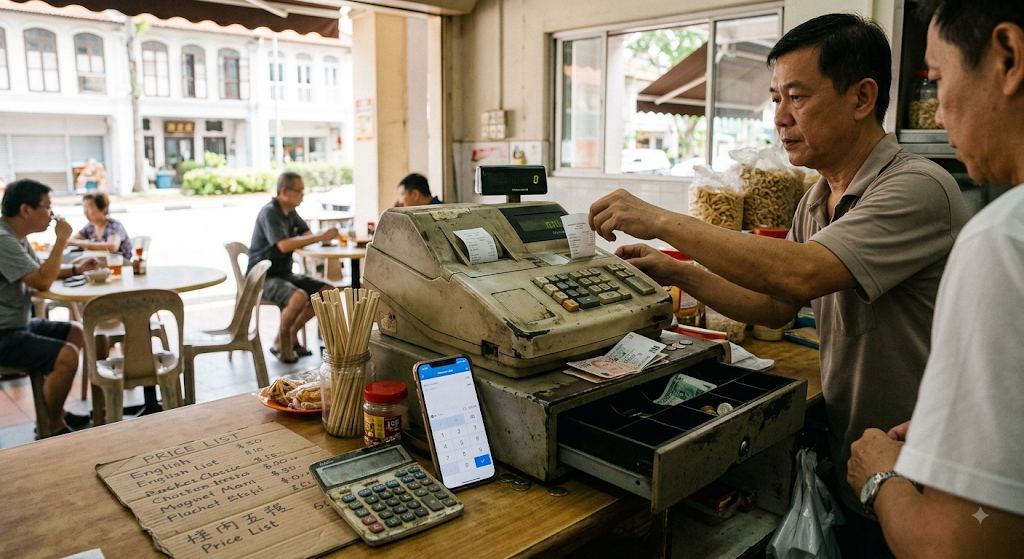
Tools built for a lean counter team look different from enterprise software built for a dedicated ops department.
Singapore's SMEs are deepening digitisation — just slowly, and unevenly
The average number of digital areas adopted per SME has been climbing steadily, and government-backed schemes have pushed adoption further. But this progress tends to concentrate in payments and basic productivity tools — the parts of the business easiest to digitise with minimal disruption — while systems touching the actual customer relationship, like receipts and CRM, remain the last mile.
What actually gets SMEs unstuck
- Tools that sit alongside existing systems, not ones requiring a full POS replacement — removing the biggest perceived cost and disruption barrier.
- Interfaces built for lean teams, not enterprise IT departments — removing the skills-gap barrier.
- Visible, immediate value — like an automatic customer record building itself — rather than abstract 'digital transformation' benefits that are hard to quantify upfront.
The takeaway for Singapore merchants
The slow pace of checkout digitisation among Singapore SMEs isn't a sign of reluctance — it's a rational response to tools that have historically demanded too much cost, disruption, and technical skill relative to what a small counter team can absorb. The fix isn't convincing merchants that digitisation matters; most already know. It's removing the friction that's kept them from acting on it.
See it running on your own counter
Free demo, no commitment. We bring the device to you.