The sticker price isn't the real cost
Most merchants evaluate their POS system by what it cost to install and what it costs to maintain — hardware fees, software subscriptions, occasional repairs. Those are real costs, but they're also the visible ones. The more expensive costs of running an outdated POS tend to be invisible, spread thin across daily operations, and easy to write off as 'just how things are.'
Cost 1: staff time lost to workarounds
Outdated systems rarely fail outright — they just require more manual effort to work around their limitations. Staff manually cross-checking totals, re-entering data the system should have captured automatically, or handling paper printouts because the system has no digital receipt option. None of this shows up as a line item, but it's real labour cost, every single shift.
Cost 2: no usable customer data
Older POS systems were built purely to process transactions, not to retain any insight about who made them. This means a merchant running an outdated system genuinely has no way to answer basic questions — who are my repeat customers, what's my average spend per visit, which items sell together — without manual analysis that most small teams don't have time for.
Cost 3: falling behind on payment expectations
With digital payments now the overwhelming default in Singapore, an outdated POS that struggles with modern payment methods or lacks integrated digital receipt capability creates friction right at the point of sale — the one moment a merchant can least afford friction. Customers increasingly expect a fast, digital-native checkout experience, and a lagging POS quietly signals a business that hasn't kept up.
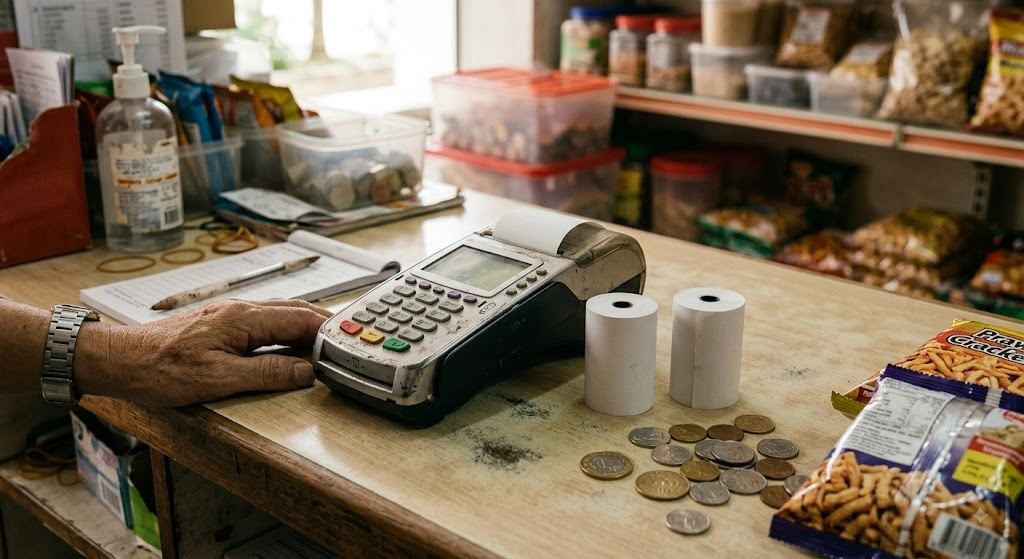
Modernising the checkout experience doesn't require ripping out the POS — often it means adding a thin layer on top of it.
Cost 4: the compounding effect on thin margins
Singapore F&B businesses often operate on margins in the single digits. Against that backdrop, small recurring inefficiencies — a few extra minutes of staff time per shift, a missed opportunity to identify a high-value repeat customer, a slower checkout during peak hours — aren't trivial. They compound, quietly eating into margins that have very little room to absorb waste.
The good news: fixing this doesn't mean replacing the POS
The instinct is to assume solving these hidden costs means a full POS overhaul — new hardware, new software, retraining staff from scratch. In many cases, the actual fix is much narrower: a lightweight layer added alongside the existing POS that handles digital receipts and customer data capture, without touching the parts of the system that already work.
- Audit what's actually manual today — receipt printing, customer follow-up, spend tracking — these are usually the easiest wins.
- Look for tools that integrate rather than replace — lower cost, lower disruption, faster to actually implement.
- Value the data, not just the transaction speed — an outdated POS's biggest hidden cost is usually the customer insight it never captured.
See it running on your own counter
Free demo, no commitment. We bring the device to you.