Same transaction, two very different outcomes
A paper receipt and a digital receipt both do the same basic job — confirm what was bought, for how much, with GST accounted for. But what happens after the receipt is issued is where the two diverge completely, and that difference matters more to a merchant's bottom line than it first appears.
Singapore has already gone almost entirely cashless at the point of sale, with the vast majority of transactions processed digitally. Yet the receipt that confirms that digital transaction is, for most merchants, still printed on paper — a strange gap in an otherwise fully digital checkout flow.
Cost: a recurring expense vs a one-time setup
Paper receipts carry a continuous cost: thermal paper rolls, printer maintenance, replacement parts, and staff time spent reloading rolls or clearing jams during a rush. None of these costs are large individually, which is exactly why most merchants never total them up — but they never stop, for as long as the business operates.
Digital receipts shift this to a largely fixed setup cost. Once a merchant has a way to issue receipts digitally, the marginal cost of each additional receipt is close to zero — no paper roll to restock, no printer to service specifically for receipts.
Compliance: both can be GST-compliant, only one keeps a permanent record
Paper and digital receipts can both meet Singapore's GST-compliant receipt requirements when properly itemised. The difference shows up after the transaction: a paper receipt's only copy is the one in the customer's hand, which fades, gets lost, or is thrown away almost immediately. A digital receipt persists — the customer can retrieve it weeks later, and the merchant retains a searchable digital record without needing to keep a physical paper trail.
Customer data: one captures it, one doesn't
This is the single biggest practical difference. A paper receipt captures nothing beyond the transaction itself — once the customer walks out, the merchant has no way to identify them again. A digital receipt, delivered via a tap or scan, naturally creates a customer touchpoint: visit history, spend, and repeat-purchase patterns can all be tracked automatically, without any extra data entry from staff.
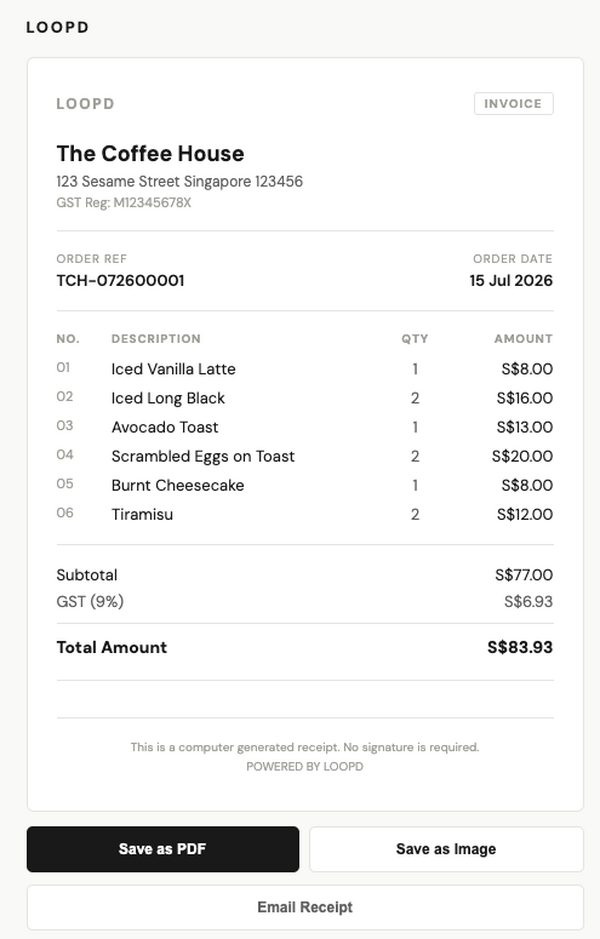
Same transaction details, itemised and GST-compliant either way — but only one keeps a usable record after the customer leaves.
Customer experience: familiar either way
A common worry among Singapore merchants is that digital receipts assume every customer is comfortable with new technology. In practice, most Singapore consumers already tap their phones constantly for contactless payments — a receipt tap uses the exact same motion. No app download or account creation is required for the customer to receive it.
What actually changes for a merchant's operations
- Paper receipts: require an ongoing paper supply, printer upkeep, and generate no usable customer data after the sale.
- Digital receipts: require a one-time setup, remove the recurring paper cost, and automatically build a customer record with every transaction.
- Neither requires replacing an existing POS system if the digital option is chosen well — the receipt layer can sit alongside what a merchant already uses.
The honest verdict
For a Singapore merchant already processing almost every payment digitally, sticking with a paper receipt as the final step of the transaction is increasingly the odd one out — not because paper receipts don't work, but because they quietly cost more, keep no record, and hand back nothing useful once the sale is done.
See it running on your own counter
Free demo, no commitment. We bring the device to you.