Home-based businesses run on relationships, not systems
A home-based bakery, a home tuition service, a small home-run retail operation — these businesses are built almost entirely on word of mouth and repeat customers, often tracked through nothing more than a phone's contact list, a WhatsApp chat history, or the owner's own memory. This works surprisingly well at small scale. It stops working the moment the business grows past what one person can hold in their head.
Why CRM tools rarely fit this segment
Most CRM and customer management tools on the market are built for businesses with a storefront, a POS system, and often a dedicated staff member managing customer relationships. Home-based businesses typically have none of these — just one person running sales, fulfilment, and customer service simultaneously, usually from a personal phone. Enterprise-style CRM tools designed for retail or F&B businesses simply don't map onto this reality, which is part of why so many home-based sellers never adopt one at all.
The problem this creates as the business grows
When a home-based business is small, tracking customers manually is manageable. As order volume grows, this manual approach starts silently costing the business in specific, measurable ways: forgotten follow-ups with past customers, no visibility into who the highest-value repeat buyers actually are, and no easy way to identify who hasn't ordered in a while and might be worth reaching out to again.
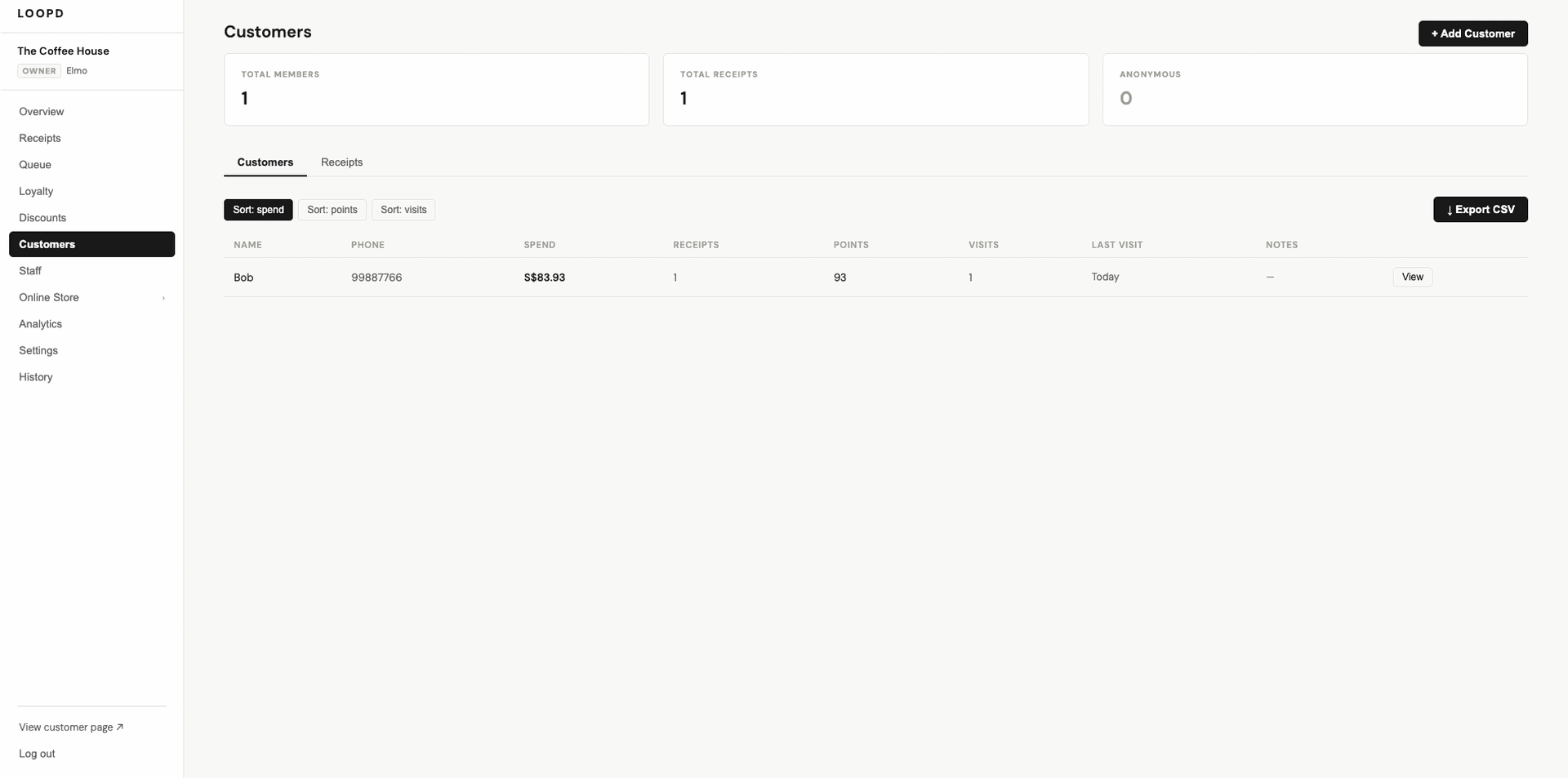
A CRM record doesn't need to be complex to be useful — visit frequency and spend history alone unlock most of the value.
What a lightweight solution actually needs to look like
- No dedicated staff required — the record should build itself from transactions, not require manual logging by a solo operator.
- No new hardware or storefront assumption — home-based businesses often transact via WhatsApp, bank transfer, or delivery handoff, not a fixed counter.
- Genuinely simple to act on — a solo operator needs to glance at who's a repeat customer, not run a report.
Why this matters more as home-based businesses formalise
As more home-based sellers in Singapore register formally and grow beyond a side income, the informal, memory-based approach to customer relationships becomes a genuine constraint on growth — not because the relationships aren't strong, but because there's no way to systematically act on them at any scale beyond what one person can personally remember.
The opportunity for home-based businesses
The CRM problem for home-based businesses isn't a lack of care about customers — if anything, home-based sellers often have closer, more personal relationships with buyers than larger retail competitors. The gap is purely structural: no tool has historically been built simply enough for a one-person operation to use without it feeling like overhead. Closing that gap doesn't require becoming a bigger business — it requires a system that fits the business exactly as it already runs.
See it running on your own counter
Free demo, no commitment. We bring the device to you.