A receipt in this sector is rarely just a receipt
Most retail and F&B receipts confirm a simple transaction — items, prices, GST. Optometry and healthcare receipts often carry meaningfully more: a prescription, a collection or fitting date, a diagnosis code, insurance or claim references. This information is genuinely useful to a patient well after the visit, yet it's typically printed once, handed over, and just as easily lost as any ordinary retail receipt.
The data is usually already captured — it just isn't surfaced
Most POS and practice management systems used in optometry and healthcare settings already capture this detailed information as part of standard record-keeping. The gap isn't data capture — it's that this same information rarely makes it onto what the patient actually takes home. A prescription that exists in the practice's internal system but not on a retrievable, patient-facing record forces patients to call back or return in person for details they should already have.
Why this matters more here than in retail
A lost retail receipt is usually a minor inconvenience. A lost prescription or collection reference is a genuine disruption — a patient may need to call the practice, wait for a callback, or in some cases return in person just to retrieve information that was already generated at their original visit. Digital receipts that persist and remain retrievable directly reduce this kind of avoidable friction for both patient and practice.
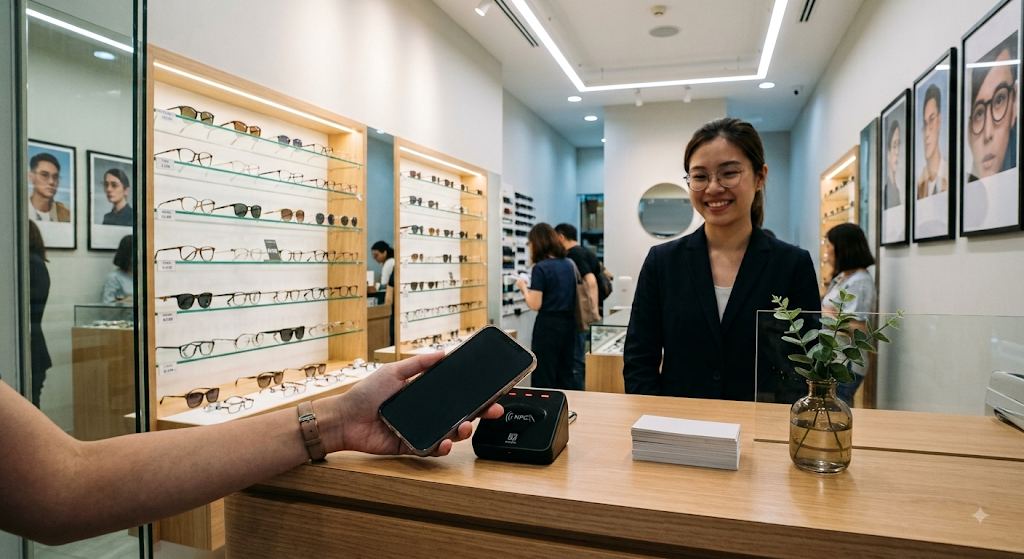
Custom fields — prescriptions, collection dates, diagnosis references — can be built directly into a digital receipt template.
What a digital receipt can carry in this sector
- Prescription details — retrievable by the patient at any time, not just at the point of collection.
- Collection or follow-up dates — reducing missed appointments or forgotten pickups.
- GST-compliant itemisation — the same compliance requirement every merchant needs to meet, handled the same way.
- A permanent visit history — useful for both the patient and the practice when questions come up later.
Implementation without disrupting patient flow
A common concern in healthcare-adjacent settings is that any new system risks slowing down patient throughput. In practice, a digital receipt layer that sits alongside an existing POS or practice management system doesn't change how staff process a transaction — it changes only what the patient receives afterward, via a simple tap of their phone rather than a printed slip.
The bigger picture for Singapore healthcare and optometry practices
As Singapore's broader digitalisation push continues across SMEs, healthcare-adjacent practices have a genuine opportunity to lead rather than lag — not because the underlying technology is complex, but because the information they already generate is unusually well-suited to being captured and returned to the patient digitally, with real, ongoing value beyond the moment of the transaction.
See it running on your own counter
Free demo, no commitment. We bring the device to you.